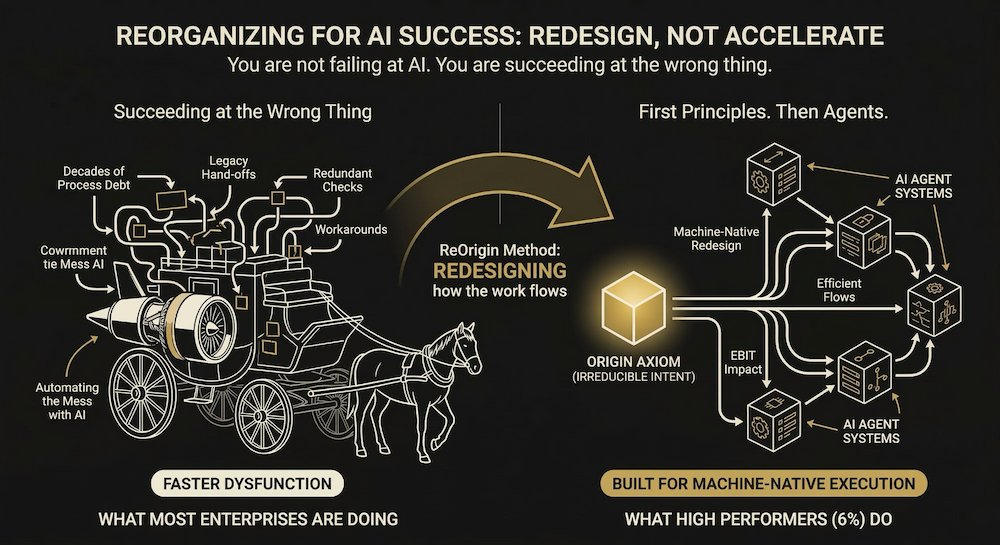
The technology works. The models are capable. The failure is structural — a fundamental misunderstanding of what transformation actually requires. And it is almost universal.
Most enterprise AI investments are not transformation efforts. They are acceleration efforts. And acceleration in the wrong direction is not neutral — it compounds the problem.
The average enterprise has accumulated decades of process debt. Workflows designed for different tools, different constraints, different assumptions about how work gets done. Every workaround that became a procedure. Every hand-off that exists because a human needed to check the work of another human. Every approval layer added not because it was necessary, but because a mistake happened once and no one ever removed the safeguard.
When you apply AI to these workflows — even excellent AI — you are encoding and accelerating a set of assumptions that were never correct to begin with. The approval layer remains. The hand-off point remains. The redundant check remains. The process moves faster. The dysfunction moves faster with it.
This is not an AI problem. It is a first-principles problem. Organisations are asking: "How do we add AI to what we have?" They should be asking: "Given what AI makes possible, what should we have?"
"It's like installing a jet engine on a horse-drawn cart. The engine works fine — the vehicle just isn't designed for it."
The research is unambiguous. Of all 31 organisational variables tested for correlation with AI-driven EBIT impact, fundamental workflow redesign ranks first. Not model selection. Not data quality. Not tool adoption. Redesigning how the work itself flows.
High performers are nearly three times more likely to have redesigned their workflows. They don't add AI to a process — they use the existence of AI as a reason to ask whether the process should exist at all.
The organisations stuck in pilot purgatory — the 94% who are not high performers — share a common characteristic: they are treating AI as a tool to be added to the organisation they already have. The 6% are asking a more fundamental question: given that agents are now a native execution primitive, what organisation should we be?
Every business has a true origin — a set of irreducible axioms that explain why it creates value. Most organisations have never explicitly named them.
They encoded the intent in process. They hired people to execute the process. They built systems to support the process. They onboarded new employees into the process. And somewhere along the way, the process became the organisation — a map so comprehensive that everyone forgot there was a territory underneath.
The hand-off point that exists because once, in 2009, a miscommunication cost a client relationship. The four-stage approval process that made sense when the company had seventeen employees and no shared systems. The weekly status meeting that was started by a manager who has since left, for a project that completed three years ago. Every one of these is a workaround masquerading as process. Every one of them is being faithfully replicated by the AI tools being layered on top.
The question no one is asking — the question that changes everything — is: if you were starting this business today, with multi-agent systems as the native execution layer, what would you build? Not automate. Build.
First-principles thinking is not a methodology. It is a discipline of questioning — the refusal to accept inherited structure as a constraint.
In physics, a first-principles calculation derives results directly from fundamental laws rather than from prior models or empirical observations. You start with what is irreducibly true, and you reason forward. Nothing is assumed. Nothing is inherited. The only constraint is reality itself.
Applied to enterprise operations, this means asking: what does this function actually exist to do? Not what does it currently do — what does it exist to do? What value does it create, for whom, and through what irreducible mechanism? If you could design this function today, with no legacy, no existing systems, and no human-scale constraints on execution, what would you build?
When you answer that question honestly — when you name the axiom clearly — the path forward becomes obvious. Not just more efficient. Not just faster. A fundamentally different operating model, designed for a world in which coordinated multi-agent systems can execute complex, multi-step workflows without the human relay points that current processes were built around.
The technology does not limit you anymore. The organisation does. That is the only thing ReOrigin changes.
Before any proposal is made, we run a structured diagnostic: axiom clarity, process debt ratio, machine-to-machine readiness, API surface coverage, and delta potential. Most engagements skip this. For us, it is the only thing that determines whether reconstruction is warranted and what shape it should take.
An origin scan report scoring your organisation across five signals, with a specific delta potential figure and an honest assessment of reconstruction readiness.
We trace backward through every value-creating function until we find the load-bearing truth beneath the accumulated process. Not the workflow — the intent the workflow was built to serve. For most organisations, this is the first time the axiom has ever been made explicit. It is also the first time reconstruction becomes possible.
A named axiom for each function in scope — the irreducible statement of what the function exists to do, stripped of all historical process assumptions.
Given the axiom, and given multi-agent systems as the native execution primitive, what becomes possible? Not probable — possible. We define the destination: a specific, measurable operating model that could not have existed without the redesign. This is the vector. The gap between current state and possible state. The exact scope of what reconstruction delivers.
A vector specification: the target operating model, the delta it represents, and the specific capabilities that close the gap between current operations and possible operations.
We build the new operating model. Multi-agent systems designed from the axiom up — not retrofitted onto existing workflows. API-first architecture that exposes every system, data source, and process as a composable surface. Machine-native execution across every value-creating function. The operating model as the product.
A production operating model — multi-agent systems in deployment, coordinated through an API-first mesh, measured against the delta defined in phase three.
Before the workflow. Before the automation. Before the agent. We start where no one else starts — at the axiom — and build forward from there.
Begin the inquiry